
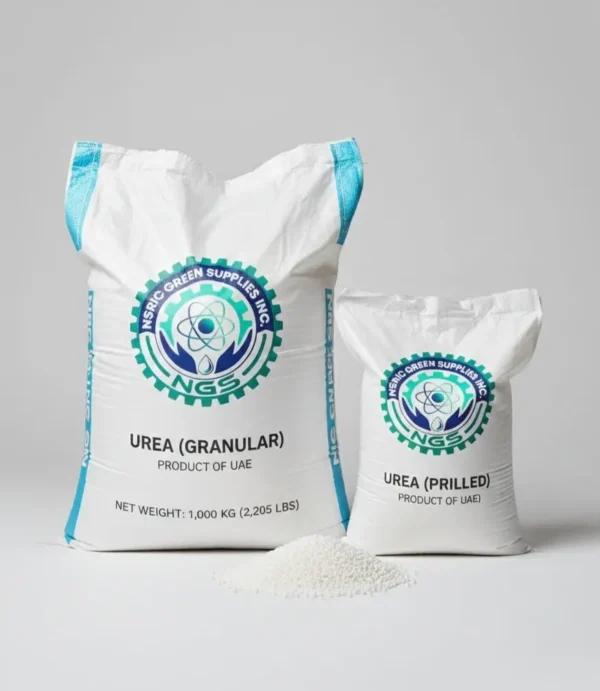
Urea (Prilled & Granular) | High Purity 46% Nitrogen Fertilizer
Urea (Prilled & Granular): Urea (CO(NH₂)₂) is a highly concentrated, solid nitrogen fertilizer that is also a vital industrial raw material. Containing 46% nitrogen, it offers the highest nitrogen content of any common solid fertilizer, making it a cost-effective and efficient choice for agricultural and industrial applications .
While chemically identical, urea is commercially available in two main physical forms: Prilled and Granular.
-
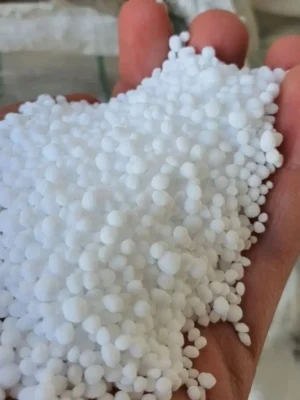
Prilled Urea: Produced by spraying molten urea into a prilling tower, forming small, spherical particles. It is known for its low dust and easy flowability, but its smaller size can make it more susceptible to moisture.
-
Granular Urea: Produced through a granulation process, layering urea onto seed particles to create larger, more durable granules. This form is preferred for bulk blending with other fertilizers like DAP or potash due to its similar particle size .
Both forms share the same Chemical Formula: CH₄N₂O and CAS Number: 57-13-6 .
Chemical Structure
Urea is an organic compound with the chemical formula CH₄N₂O. Its structure consists of a carbonyl group (C=O) attached to two amine groups (NH₂). This simple yet highly effective molecule is a source of nitrogen that plants can readily metabolize. It is a white, crystalline solid with a melting point of approximately 135°C and is highly soluble in water .
H3: Technical Details
Understanding the technical specifications is crucial for quality assurance. A typical high-quality urea product will meet stringent parameters:

| Parameter | Specification | Benefits |
|---|---|---|
| Nitrogen Content | ≥ 46% by weight | Maximizes nutrient delivery and economic value . |
| Biuret Content | ≤ 1.0% (typically <0.5%) | Biuret is a toxic impurity. Lower levels are safer for foliar applications and sensitive crops . |
| Moisture Content | ≤ 0.5% | Prevents caking and maintains free-flowing properties . |
| Particle Size (Mean) | Prills: ~1.6mm Granules: ~2.8mm |
Granules are ideal for bulk blending; prills are suited for direct application . |
H3: Packaging Information
Urea is typically packaged to ensure product integrity and ease of handling. Common packaging options include:
-
50kg Bags: The most standard form for retail and small-scale use. Polyethylene-lined woven bags protect the product from moisture ingress .
-
Bulk Bags (FIBCs/Jumbo Bags): Holds 500kg to 1,500kg of urea. Used for large-scale agricultural operations and industrial consumers.
-
Bulk Transport: For large shipments, urea is transported in bulk via container ships, barges, and trucks. It is crucial to use food-grade containers for sensitive applications and to adhere to strict cleaning protocols to prevent cross-contamination .
Purity, Testing & Quality Assurance
Stringent quality control is essential for urea. A typical Certificate of Analysis (COA) ensures the product meets industry standards. Key tests include:
-
Assay (Purity): A standard high-grade product will demonstrate an assay of approximately 99.4% or higher .
-
Biuret Determination: High-Performance Liquid Chromatography (HPLC) is often used to accurately quantify biuret and other organic impurities like cyanuric acid and triuret .
-
Moisture Analysis: Karl Fischer titration is the standard method for determining moisture content, ensuring it remains below the acceptable limit .
Request the Current COA
A Certificate of Analysis (COA) is a document that confirms the product meets its required specifications for quality and purity. It is essential for your quality assurance documentation.
A sample COA typically includes:
-
Appearance: White prilled/granular solid.
-
Purity: >99.0% (often ~99.4%) .
-
Biuret: ≤1.0% (often ~0.45%) .
-
Moisture: ≤0.5% (often ~0.15%) .
-
Iron (Fe): ≤5 ppm .
Common research applications include:
-
Agriculture: As a high-concentration nitrogen fertilizer for a wide range of crops including corn, wheat, and vegetables. It can be applied as a base or top-dressing .
-
Biochemistry: Used as a protein denaturant for unfolding proteins and solubilizing inclusion bodies in research and biopharmaceutical manufacturing. It is also used in protein purification processes .
-
Industrial Chemicals: A key raw material for producing melamine and urea-formaldehyde resins used in plastics and adhesives .
-
Automotive: As a key component in the production of AdBlue (diesel exhaust fluid), which reduces NOx emissions from diesel engines .

Precautions
-
Eye Irritation: Urea can cause eye irritation. In case of contact, rinse thoroughly with water and seek medical attention if symptoms persist .
-
Hygroscopic: Urea absorbs moisture from the air. Store in a cool, dry, well-ventilated area, ideally in sealed containers, to prevent caking and degradation .
-
Handling: Use appropriate personal protective equipment (PPE) such as gloves and safety goggles to prevent exposure .
-
Volatilization: When applied to soil, urease enzyme converts urea to ammonia, which can be lost to the atmosphere. Applying before rain or incorporating it into the soil minimizes this loss




Reviews
There are no reviews yet.